
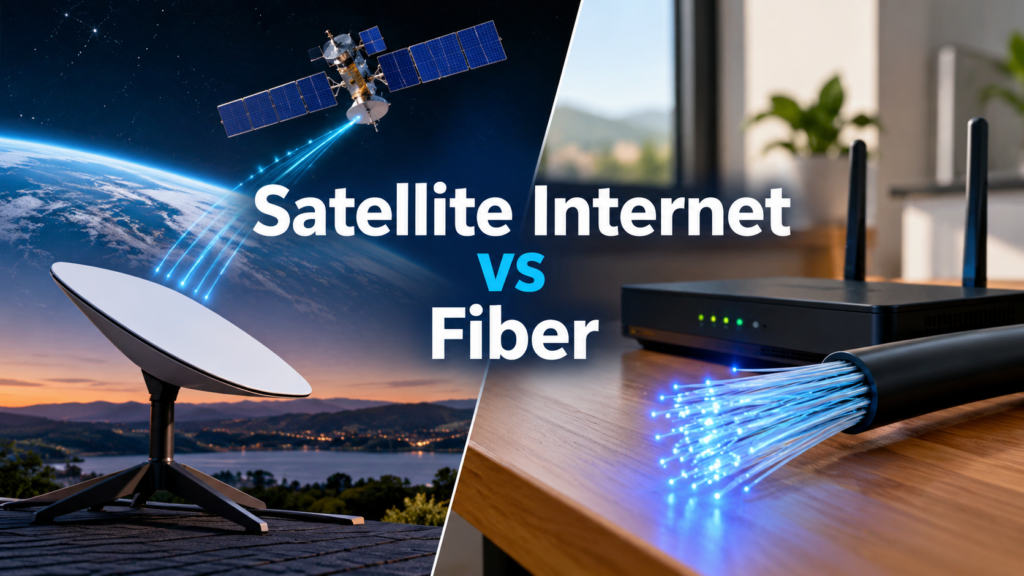
Satellite Internet vs Fiber Speed, Cost, and Reliability
When comparing satellite internet vs fiber, the biggest differences involve speed, latency, monthly costs, and availability. Fiber internet uses cables to transmit data, while satellite internet sends information between a user’s equipment and satellites in orbit. Each option has advantages, but the right choice depends on location, budget, and internet usage.
Understanding these differences helps households and businesses make an informed decision without paying for features they do not need.
What Is Satellite Internet?
Satellite internet provides an internet connection through communication satellites rather than a direct physical cable running to a property. A satellite dish or compatible terminal communicates with a satellite, which connects the user to the wider internet through ground infrastructure.
This technology is particularly useful in rural areas, remote communities, and locations where traditional broadband networks are unavailable. It can bring internet access to homes that would otherwise have few practical options.
Modern low Earth orbit satellite services can deliver considerably lower latency than older satellite systems. However, performance still depends on the service provider, satellite coverage, equipment, network congestion, and local conditions.
How Satellite Internet Works
A satellite internet connection typically requires a dish or terminal, a modem or integrated networking device, and a Wi-Fi router or compatible built-in system.
When someone opens a website, the request travels from the connected device through the local network and satellite equipment. It then passes through the satellite network and ground infrastructure before reaching the destination server. The response follows a similar route back.
Because this process involves wireless communication over long distances, latency can be higher than with a direct fiber connection. Weather, obstructions, and network congestion may also affect performance, depending on the satellite technology.
What Is Fiber Internet?
Fiber internet uses optical fibers to transmit data as pulses of light. These thin strands of glass or plastic carry information over long distances with high capacity and relatively little signal loss.
Fiber-optic broadband is widely regarded as one of the strongest options for homes and businesses that need fast, consistent internet access. It supports activities such as video conferencing, large file transfers, cloud applications, online gaming, and high-resolution streaming.
Its main limitation is availability. Installing fiber infrastructure requires physical network equipment and cables, so some rural or remote properties cannot access it.
How Fiber Internet Works
Fiber internet connects a property to a broadband network through fiber-optic cables. An optical network terminal or similar equipment converts the incoming optical signal into a connection that devices can use.
A router then distributes the connection throughout the home or workplace, usually through Wi-Fi or Ethernet.
Because data travels through fiber rather than making a long wireless journey to a satellite, fiber connections generally offer lower latency and more consistent performance. However, actual results still depend on the provider’s network, the chosen plan, router quality, and local network congestion.

Satellite Internet vs Fiber at a Glance
The following comparison highlights the main differences between the two technologies.
| Feature | Satellite Internet | Fiber Internet |
|---|---|---|
| Connection method | Wireless communication with satellites | Optical fiber cables |
| Download speed | Varies by service and network conditions | Often very high, depending on the plan |
| Upload speed | Varies; may be lower than download speed | Often faster and more consistent |
| Latency | Usually higher, especially with geostationary satellites | Generally very low |
| Reliability | Can be affected by obstructions, weather, or congestion | Usually stable, though outages can occur |
| Availability | Can serve many remote locations with a clear view of the sky | Limited to areas with installed infrastructure |
| Installation | Usually requires a satellite terminal or dish | Requires an available fiber connection |
| Best suited for | Remote homes and locations without wired broadband | Homes and businesses with fiber coverage |
Neither technology is automatically the best choice for every user. Fiber usually performs better when available, while satellite can provide essential connectivity where cable-based broadband is impractical.
Speed Comparison Between Satellite and Fiber
Internet speed affects how quickly websites load, how smoothly videos stream, and how long large files take to download or upload. Both technologies can support everyday online activities, but their performance characteristics differ.
Download Speeds
Satellite internet speeds vary significantly between providers and plans. Modern satellite services can support video streaming, browsing, remote work, and multiple connected devices, although speeds may fluctuate with network demand.
Fiber broadband commonly offers much higher download capacity, with plans ranging from hundreds of megabits per second to multi-gigabit speeds in supported areas.
For a household that regularly downloads large games, transfers substantial files, or streams high-resolution video across several devices, fiber often provides more headroom.
Upload Speeds
Upload performance matters for video calls, cloud backups, content creation, and sending large files to clients or colleagues.
Some satellite services offer sufficient upload capacity for everyday work, but performance can vary. Fiber plans often provide stronger upload speeds, and some providers offer symmetrical connections where upload and download rates are similar.
For professionals who regularly upload videos, manage cloud-based projects, or work with large design files, this difference can be particularly important.
Does Faster Internet Always Mean Better Performance?
Not necessarily. A connection’s advertised speed is only one part of the experience. Latency, packet loss, network congestion, and the quality of the home router also affect performance.
A fast connection with high latency may feel less responsive during online gaming or remote desktop sessions. Likewise, a household with a modest internet plan and a well-positioned router may enjoy a better experience than one with a faster plan and poor Wi-Fi coverage.
Latency and Online Responsiveness
Latency refers to the time data takes to travel between a device and a server. It is commonly measured in milliseconds. Lower latency generally means a quicker response when users interact with websites, games, and online applications.
Why Fiber Usually Has Lower Latency
Fiber connections generally deliver low latency because data travels through a wired network with an efficient route to the internet. Although distance to the server and network congestion still matter, fiber usually provides a responsive experience.
This makes it a strong choice for competitive gaming, video calls, remote work, and applications that depend on quick two-way communication.
How Satellite Latency Varies
Satellite latency depends heavily on the type of satellite system.
Traditional geostationary satellites orbit far above Earth, creating a long round trip for data. This can introduce substantial delays, even when download speeds are acceptable.
Low Earth orbit satellite networks operate much closer to the planet and can offer significantly lower latency than geostationary systems. Nevertheless, they do not necessarily match fiber’s responsiveness in every situation.
For activities where timing matters, such as fast-paced online games or interactive remote applications, fiber generally has the advantage.

Cost Comparison Between Satellite Internet and Fiber
Price is another important factor when comparing internet services. The monthly subscription is only part of the total expense. Equipment, installation, service restrictions, and additional charges can also affect the overall cost.
Satellite Internet Costs
Satellite providers may charge for a service plan, equipment rental or purchase, installation, and shipping. Some services include equipment in their packages, while others require a separate upfront payment.
The final cost depends on the provider, location, available plan, and equipment requirements. Remote properties may also face limited provider choices, which can make comparing prices more difficult.
Satellite internet can still represent good value when it provides access in an area without suitable alternatives. The cost should be considered alongside the benefit of having a usable connection at all.
Fiber Internet Costs
Fiber plans often have competitive monthly prices in areas with established broadband infrastructure. Providers may offer different speed tiers, introductory discounts, and bundles with other services.
Installation might be included, although some properties require additional work or charges before service can begin. Availability also affects pricing because customers cannot choose a fiber package that is not offered at their address.
When comparing plans, households should check the regular monthly price after any promotional period, equipment charges, contract terms, and installation fees.
Which Option Offers Better Value?
Fiber often provides stronger value in areas where several providers compete and installation is straightforward. It can deliver high speeds and low latency without requiring satellite-specific equipment.
Satellite may offer better practical value in remote locations where wired broadband is unavailable or prohibitively expensive to install.
The most useful comparison considers the full cost over the expected contract period rather than focusing on the advertised monthly price alone.
Reliability and Weather Conditions
A dependable internet connection is important for work, education, entertainment, and communication. Although both technologies can provide reliable service, they face different challenges.
Satellite Internet Reliability
Satellite performance depends on several factors, including the satellite network, the user’s equipment, the view of the sky, and network congestion.
Heavy rain can affect some satellite signals, while trees, buildings, and other obstructions can interfere with reception. The severity depends on the system and local conditions.
Modern satellite networks can provide a useful connection in places with limited infrastructure, but users should check installation requirements and expected performance in their area.
Fiber Internet Reliability
Fiber-optic cables are not affected by rain in the same way as a satellite signal traveling through the atmosphere. As a result, fiber generally offers consistent performance during ordinary weather conditions.
However, it is not immune to outages. Cable damage, equipment failures, power interruptions, and problems elsewhere in the provider’s network can disrupt service.
For businesses that rely on constant connectivity, a backup connection may be worth considering regardless of the primary technology.
Availability in Rural and Urban Areas
Availability is often the deciding factor when comparing these options. The fastest or cheapest package has little value if a property cannot receive it.
Satellite Internet for Remote Locations
Satellite internet can serve properties far from major towns, including rural homes, farms, cabins, and isolated work sites. Its coverage does not depend on a fiber cable reaching every building, although service eligibility and equipment requirements still vary by provider.
This makes satellite an important option for people who live beyond the reach of conventional broadband networks.
Fiber Internet in Cities and Towns
Fiber is often easier to obtain in urban areas and communities where providers have already installed the necessary infrastructure. Some suburban and rural locations also have fiber access, but coverage can differ between streets and even between nearby properties.
Before selecting a plan, customers should confirm availability using their exact service address rather than relying on a provider’s general coverage map.

Which Internet Type Is Better for Gaming and Streaming?
Entertainment requirements can help narrow the choice. However, the best connection depends on the type of game, video quality, number of users, and overall network performance.
Online Gaming
Fiber is usually the stronger option for online gaming because low latency and stable performance help games respond quickly to player actions.
Satellite can support many online games, particularly when a modern low Earth orbit service is available. However, higher latency or changing network conditions can create disadvantages in competitive games that require precise timing.
Video Streaming
Both technologies can support video streaming when their available speeds meet the service’s requirements.
A suitable satellite plan can handle high-definition video and may support higher-resolution content, depending on the network conditions and number of connected devices. Fiber offers more consistent capacity for households that stream across several screens at the same time.
For most households with access to a suitable fiber plan, fiber is the more flexible option for demanding entertainment use.
Satellite Internet vs Fiber for Remote Work and Businesses
Reliable internet access helps businesses communicate with customers, use cloud software, transfer files, and collaborate with remote teams.
Fiber is often preferable for offices that depend on video meetings, cloud platforms, large uploads, or real-time business applications. Low latency and consistent upload performance can make daily work more efficient.
Satellite internet can be a practical alternative for remote offices, agricultural operations, field teams, and businesses operating outside wired broadband coverage. It can also provide connectivity at temporary sites where installing a physical network would be difficult.
Businesses should consider their operational needs before choosing a service. An organization that mainly uses email and web applications may have different requirements from one that transfers large files or hosts real-time services.
Installation and Equipment Requirements
Installation is another practical difference between the two technologies.
Satellite internet usually requires a compatible dish or terminal positioned with a suitable view of the sky. Depending on the service, professional installation may be recommended or required. The equipment also needs an appropriate location and access to power.
Fiber installation requires an available fiber network and a connection to the property. Technicians may need to install or activate an optical terminal before the service can be used.
Both options can distribute internet through Wi-Fi, so the router’s quality and placement remain important. Thick walls, long distances, and interference can reduce wireless performance even when the incoming connection is excellent.
Can Satellite Internet Replace Fiber?
Satellite internet can replace fiber when a property lacks access to wired broadband or when a satellite plan better suits the location. Modern satellite services have made internet access possible in many places where traditional infrastructure is limited.
However, replacing an available fiber connection with satellite may involve compromises in latency, consistency, upload performance, or total cost. The size of those differences depends on the specific providers and plans being compared.
For a property with dependable fiber access, switching to satellite usually makes sense only when there is a particular reason, such as mobility, a lack of reliable wired service, or the need for connectivity in a remote location.

How to Choose the Right Internet Connection
The best choice comes down to availability, usage, cost, and performance expectations.
Fiber is generally the preferred option for households and businesses that need fast downloads, strong uploads, low latency, and consistent service. It is particularly suitable for multiple users, competitive gaming, remote work, and frequent large file transfers.
Satellite is worth considering when a property is outside the reach of suitable broadband infrastructure. It can provide essential access for remote households and businesses, provided the service offers adequate performance and the equipment can be installed correctly.
Before making a decision, customers should compare real-world speed expectations, upload performance, latency, total monthly costs, installation requirements, data policies, and contract terms. Checking provider availability at the exact address is equally important.
Conclusion
The comparison between satellite internet and fiber comes down to performance versus availability in many situations. Fiber generally delivers lower latency, strong upload speeds, and consistent performance, making it an excellent choice wherever the infrastructure is available.
Satellite internet fills an important gap by connecting properties that traditional broadband networks may not reach. Although its performance varies by technology and provider, it can be a practical solution for rural homes, remote workplaces, and isolated locations.
Ultimately, the right option is the one that meets the user’s connectivity needs at a reasonable total cost. For properties with access to reliable fiber, fiber will usually be the stronger all-round choice. Where fiber is unavailable, satellite may be the most practical route to dependable internet access.
FAQs
1. Is satellite internet better than fiber?
Fiber is generally better for speed, low latency, and reliability. Satellite internet is a practical choice for rural areas where fiber is unavailable.
2. Is satellite internet faster than fiber?
Fiber usually offers faster and more consistent speeds, especially for uploads and demanding online activities.
3. Which is cheaper, satellite internet or fiber?
Fiber is often more affordable where coverage is available. Satellite costs may include additional equipment and installation fees.
4. Can satellite internet handle online gaming?
Yes, satellite internet can support online gaming, especially through low Earth orbit services. However, fiber usually provides lower latency and a smoother gaming experience.
5. Does bad weather affect satellite internet?
Yes, heavy rain and certain weather conditions can disrupt satellite signals. Fiber is generally less affected by weather, although physical damage and power outages can still cause interruptions.
Read Also: How Big Data Analytics Helps Businesses Make Decisions