
Machine Learning Autonomous Vehicle Technology and Its Benefits
Machine Learning Autonomous Vehicle helps a car learn patterns from large amounts of driving data. It allows the vehicle to recognize pedestrians, identify road signs, predict the movement of nearby vehicles, and respond to changing road conditions. Instead of following only fixed instructions, the system can use information from previous examples to improve its ability to handle different driving situations.
As automotive technology continues to develop, machine learning is becoming an essential part of intelligent transportation. However, its successful use also depends on reliable sensors, careful testing, strong safety measures, and clear regulations.
What Is Machine Learning Autonomous Vehicle?
Machine learning is a branch of artificial intelligence that enables computer systems to identify patterns in data and use those patterns to make predictions or decisions. In autonomous vehicles, this technology helps the driving system interpret information collected from the road.
A self-driving car may use cameras, radar, lidar, GPS, and other sensors to collect information about its environment. Machine learning algorithms process this information to help the vehicle understand what is happening around it.
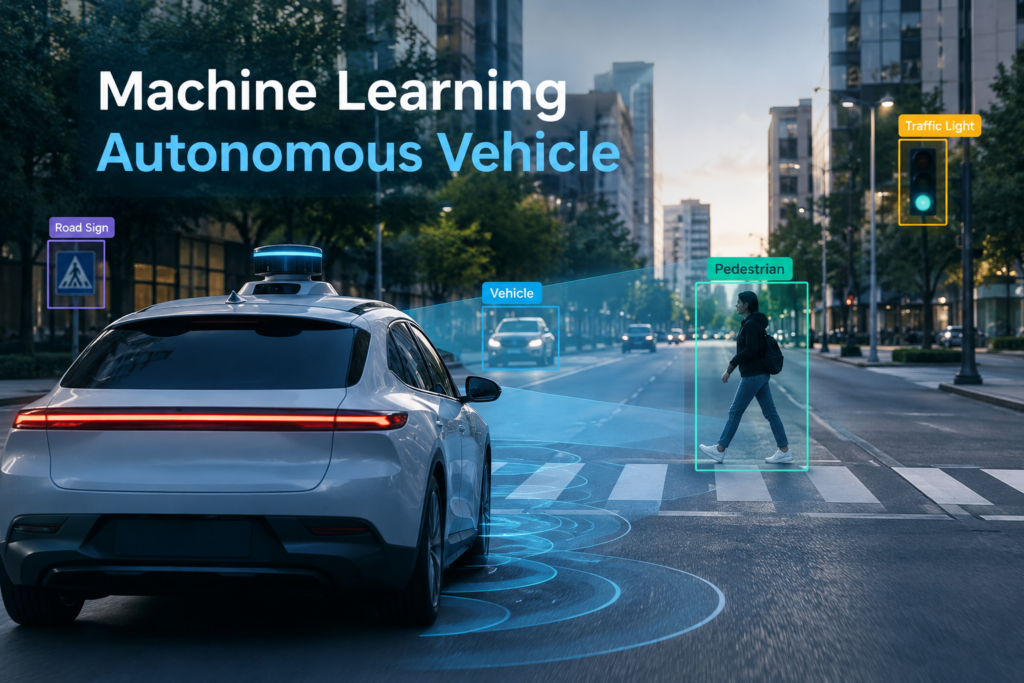
For example, a camera may capture an image of a pedestrian approaching a crossing. A trained machine learning model can identify the person and help the vehicle estimate the risk of a possible collision. The vehicle’s driving system can then use this information to determine whether it needs to slow down or stop.
The process involves more than recognizing objects. The system must also consider speed, distance, road layout, traffic signals, and the possible actions of other road users.
How Machine Learning Works in Self-Driving Cars
Machine learning supports several stages of autonomous driving. Each stage contributes to the vehicle’s ability to understand its environment and choose an appropriate response.
Data Collection and Processing
Autonomous vehicles gather information through multiple sensors. Cameras provide visual details, radar helps measure the distance and speed of objects, and lidar can create detailed three-dimensional representations of nearby surroundings.
The collected data is processed to identify useful information. Training datasets may include millions of examples of roads, traffic signs, vehicles, cyclists, pedestrians, and unusual driving situations.
The quality and diversity of these datasets matter. A model trained on varied road conditions may be better prepared to recognize situations that differ from ordinary daytime driving.
Training Machine Learning Models
During training, algorithms examine examples and learn patterns that help them complete specific tasks. For instance, an image recognition model can learn to distinguish a bicycle from a motorcycle by identifying relevant visual features.
Engineers test the trained models against separate datasets to measure their performance. They may also investigate errors, improve the training data, and adjust the model before testing it again.
This process helps developers understand where a model performs well and where it may struggle. However, strong results during training do not automatically guarantee safe performance on public roads.
Real-Time Decision-Making
Once deployed, machine learning models process incoming sensor information to support driving decisions. The vehicle must respond quickly because road conditions can change within seconds.
The system may need to detect a vehicle braking suddenly, recognize a traffic light changing, or identify a pedestrian entering the road. Other parts of the autonomous driving system use this information to plan a suitable response.
Reliable decision-making requires more than an accurate prediction. The vehicle must also consider safety constraints, uncertainty, and the possible consequences of different actions.

Key Applications of Machine Learning Autonomous Vehicle
Machine learning supports several important functions that allow autonomous vehicles to operate in complex environments.
Object Detection and Recognition
Object detection helps a vehicle identify the objects surrounding it. These may include cars, buses, motorcycles, pedestrians, cyclists, road signs, and traffic lights.
Computer vision models analyze camera images to locate and classify these objects. Their predictions help the vehicle estimate which road users or obstacles may affect its movement.
Accurate recognition is especially important in busy streets, where several objects may appear at the same time. Poor lighting, heavy rain, unusual objects, or partially hidden pedestrians can make this task more difficult.
Lane Detection and Road Understanding
Lane detection helps a vehicle identify road boundaries, lane markings, and the space available for driving. Machine learning models can analyze visual information to estimate where a lane begins and ends.
Road understanding may also involve recognizing intersections, pedestrian crossings, construction areas, and changes in road layout.
These capabilities help the driving system maintain an appropriate position and plan movements such as turning or changing lanes. Nevertheless, faded markings and roads without clear lane lines remain challenging conditions.
Predicting the Behavior of Other Road Users
Understanding what another road user might do next is an important part of autonomous driving. A vehicle needs to estimate whether a nearby car may change lanes, whether a cyclist may turn, or whether a pedestrian may cross the road.
Machine learning models use observed movement, surrounding conditions, and historical patterns to estimate possible future actions.
These predictions are not certain. A pedestrian may change direction unexpectedly, and another driver may behave in an unusual way. For this reason, safe systems need to account for multiple possible outcomes rather than relying on a single prediction.
Path Planning and Navigation
Path planning determines how a vehicle should move toward its destination while responding to nearby traffic and road conditions.
Machine learning can help estimate suitable driving actions and predict how traffic may develop. The broader autonomous driving system then evaluates possible routes or movements against safety requirements.
For example, a vehicle approaching a slower car may need to decide whether to maintain its speed, reduce its speed, or change lanes. The appropriate action depends on available space, surrounding traffic, road rules, and the risks involved.
Adaptive Cruise Control and Automated Parking
Some machine learning techniques can support driver assistance features such as adaptive cruise control and automated parking.
Adaptive cruise control maintains a selected speed while adjusting the distance from a vehicle ahead. Automated parking systems may use sensor information to identify available spaces and guide the vehicle through a parking maneuver.
These features vary in complexity and capability. Some are designed to assist a human driver rather than operate independently, so their limitations and supervision requirements must remain clear.
Types of Machine Learning Used in Autonomous Vehicles
Different machine learning approaches solve different driving problems. Developers often combine several methods rather than relying on one algorithm for every task.
Supervised Learning
Supervised learning uses labeled examples to train a model. The training data contains both the input information and the expected answer.
For autonomous vehicles, labeled images may identify pedestrians, traffic signs, lane markings, or other road objects. The model learns to associate visual patterns with the correct labels.
This approach is useful for object classification and detection. Its effectiveness depends on accurate labels and training data that represents a broad range of real-world conditions.
Deep Learning
Deep learning uses artificial neural networks with multiple layers to learn complex patterns from data. It plays a major role in modern computer vision and sensor interpretation.
Deep learning models can process large volumes of images and other sensor information. They help identify objects, understand scenes, and extract features that would be difficult to describe through simple rules alone.
However, these models may require substantial computing power, extensive training data, and careful evaluation. Their internal complexity can also make some errors harder to explain.
Reinforcement Learning
Reinforcement learning trains an agent to select actions based on feedback from its environment. During training, the agent receives rewards or penalties according to the outcomes of its actions.
In autonomous driving research, reinforcement learning may help investigate traffic behavior, control strategies, and navigation decisions. Simulations provide a controlled environment in which developers can examine many possible situations.
Because unsafe experimentation on public roads is unacceptable, learned policies require extensive validation and safety controls before real-world use.
Unsupervised and Self-Supervised Learning
Unsupervised learning looks for patterns in data without relying on conventional labels for every example. Self-supervised learning creates training signals from the data itself, reducing dependence on manually labeled datasets.
These approaches can help developers use large collections of driving videos and sensor recordings. They may support scene understanding, representation learning, and the discovery of useful patterns.
Their value depends on how well the learned representations transfer to the tasks that a vehicle must perform safely.
Benefits of Machine Learning in Autonomous Driving
Machine learning offers several potential benefits when combined with a well-designed vehicle system.
Improved Awareness of Road Conditions
Machine learning models can process information from multiple sensors and identify details that may be difficult to interpret through simple rules alone. This can help the vehicle recognize road users and respond to changing traffic conditions.
The quality of this awareness depends on sensor performance, model accuracy, and the environment in which the vehicle operates.
More Consistent Driving Decisions
Automated driving systems can apply defined decision-making processes without experiencing fatigue or distraction in the same way a human driver can.
Machine learning may help these systems recognize recurring situations and estimate appropriate responses. Even so, the technology can still make mistakes, particularly when it encounters unfamiliar or poorly represented conditions.
Better Traffic Flow and Energy Efficiency
Autonomous driving technology may help reduce unnecessary acceleration and braking when vehicles coordinate their movements effectively. More consistent driving can potentially improve energy efficiency and make traffic flow smoother.
These outcomes are not guaranteed. Traffic density, road design, driving policies, and the behavior of other vehicles all influence the results.
Support for Future Transportation Systems
Machine learning can contribute to connected transportation networks, intelligent traffic management, and more advanced mobility services.
When vehicles and infrastructure exchange reliable information, transportation systems may gain better insight into traffic conditions and potential hazards. Such improvements depend on compatible technology, secure communications, and suitable infrastructure.

Challenges of Machine Learning Autonomous Vehicle
Despite its potential, machine learning introduces technical and practical challenges that must be addressed before autonomous driving can become more widely available.
Safety in Unpredictable Situations
Roads contain countless situations that are difficult to predict. A vehicle may encounter temporary road closures, unexpected obstacles, unusual vehicle behavior, or emergency vehicles approaching an intersection.
A model that performs well under ordinary conditions may struggle with situations that were missing from its training data.
Developers must test autonomous systems across varied environments and provide safeguards for cases in which the system cannot confidently interpret its surroundings.
Weather and Sensor Limitations
Heavy rain, fog, snow, glare, and darkness can affect sensor performance. Camera images may become difficult to interpret, while other sensors can also experience environmental limitations.
Combining information from multiple sensors can improve the overall understanding of the environment. However, sensor fusion does not eliminate every failure, and the system must recognize when its available information becomes unreliable.
Large Data Requirements
Training effective models requires diverse and representative datasets. Collecting, labeling, storing, and processing this information can be expensive and time-consuming.
Rare events create an additional challenge because they may be difficult to capture in sufficient quantities. Simulation and carefully selected test scenarios can help, but simulated conditions do not perfectly reproduce every real-world situation.
Cybersecurity and Data Privacy
Connected vehicles may process location information, sensor recordings, and other potentially sensitive data. Unauthorized access could threaten privacy or affect vehicle systems.
Manufacturers need strong security practices, protected software updates, access controls, and appropriate data-handling policies. Cybersecurity must remain part of the vehicle’s design throughout its operational life.
Ethical and Legal Responsibility
Autonomous vehicles raise questions about responsibility when an accident occurs. Investigators may need to examine the vehicle’s behavior, sensor records, software decisions, and the actions of other road users.
Legal requirements differ between jurisdictions, and rules governing testing or deployment can change. Clear safety standards and accountability procedures are necessary to support public trust.
The Role of Simulation and Testing
Simulation is an important tool for developing and evaluating autonomous driving technology. It allows engineers to recreate traffic situations, vary road conditions, and test vehicle responses without exposing road users to unnecessary danger.
A simulated environment can include sudden braking, crossing pedestrians, unusual intersections, and challenging weather. Engineers can repeat the same scenario with different parameters to compare system behavior.
However, simulation alone is not enough. Models must also be evaluated through controlled physical testing and other validation methods. Testing should cover normal driving, unusual events, sensor failures, and situations where the system may need to reduce its capabilities or request human intervention.
Continuous monitoring can help developers identify problems after deployment and determine whether updates are needed.
The Future of Machine Learning Autonomous Vehicle
The future of autonomous driving will likely involve continued progress in machine learning, sensor technology, computing hardware, and vehicle safety systems.
Researchers are exploring methods that combine information from cameras, radar, lidar, maps, and other sources more effectively. Improvements in model efficiency may also help vehicles process information within practical computing and energy limits.
Another important direction involves making machine learning systems more reliable and easier to evaluate. Developers are working on better uncertainty estimation, explainability, simulation, and methods for identifying unfamiliar situations.
Connected infrastructure may also support safer traffic management by sharing information about road hazards, congestion, and changing signals.
However, technical progress alone will not determine the speed of adoption. Manufacturing costs, regulations, public confidence, cybersecurity, and real-world safety performance will all influence how autonomous vehicles develop.
Conclusion
Machine learning is a central technology in autonomous vehicles because it helps driving systems recognize objects, interpret road scenes, predict movement, and support navigation decisions. Different approaches, including supervised learning, deep learning, reinforcement learning, and self-supervised learning, contribute to different parts of this process.
The technology offers potential benefits for road awareness, driving consistency, traffic management, and future transportation services. At the same time, unpredictable road conditions, sensor limitations, data requirements, and safety concerns remain significant challenges.
The most effective approach combines machine learning with reliable sensors, carefully designed safety controls, extensive testing, and clear human oversight where required. As research and engineering improve, these combined systems may help make autonomous transportation more practical and dependable.
FAQs
What is Machine Learning Autonomous Vehicle?
Machine learning enables autonomous vehicles to identify patterns in sensor data, recognize road objects, predict possible movements, and support driving decisions.
How does machine learning help self-driving cars?
It helps self-driving cars interpret camera and sensor information, detect pedestrians and other vehicles, understand road layouts, and estimate suitable driving actions.
Which machine learning algorithms are used in autonomous vehicles?
Common approaches include supervised learning, deep learning, reinforcement learning, and self-supervised learning. Developers select methods according to the task and safety requirements.
Is machine learning enough to make a vehicle fully autonomous?
No. Autonomous driving also requires sensors, computing hardware, planning and control systems, safety mechanisms, testing, and compliance with applicable regulations.
What are the main challenges of Machine Learning Autonomous Vehicle?
Major challenges include unpredictable road situations, difficult weather, sensor failures, limited training data, cybersecurity risks, and the need to demonstrate reliable safety performance.
Read Also: Cloud Storage Small Business Benefits and Security