
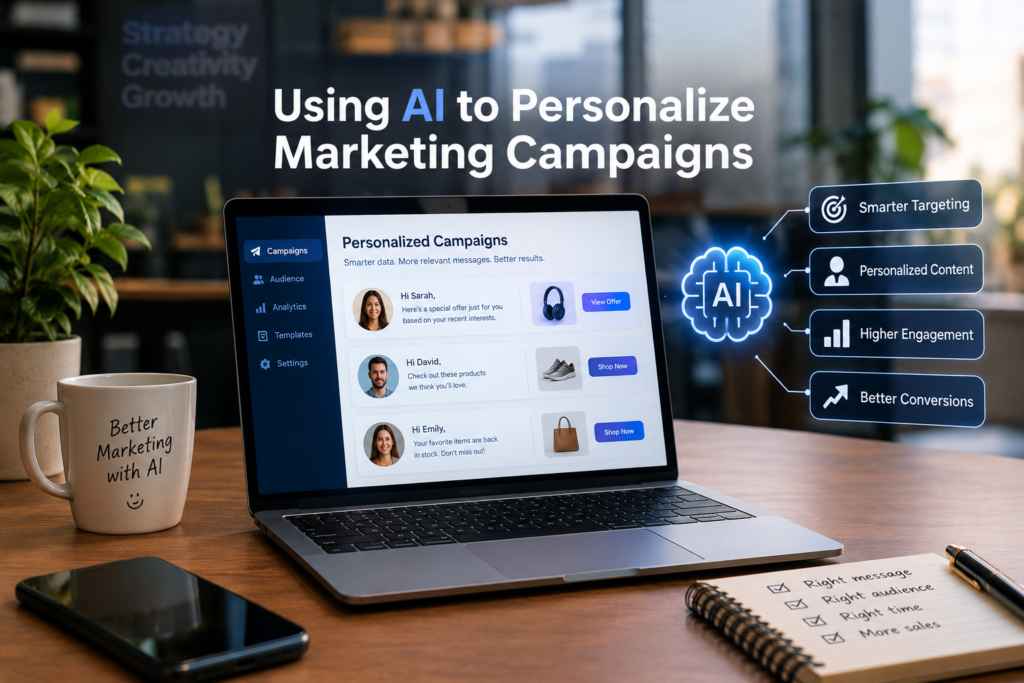
Using AI to Personalize Marketing Campaigns
Personalize Marketing Campaigns with artificial intelligence (AI) to deliver relevant messages, understand customer needs, and improve marketing performance. Traditional marketing often relies on broad messages that may not connect with every audience. AI helps businesses analyze customer data, identify preferences, and create more personalized experiences across email, websites, social media, and other marketing channels. This approach allows marketers to build stronger customer relationships, improve engagement, and make better use of their marketing budgets.
What Is AI-Powered Marketing Personalization?
AI-powered marketing personalization involves using artificial intelligence to create marketing messages and experiences that match individual customer interests. Instead of showing every customer the same advertisement or email, businesses can use customer data to make their communication more relevant.
AI systems can analyze information such as browsing activity, previous purchases, email interactions, and product preferences. Based on these patterns, they can help marketers determine which content, offers, or recommendations may appeal to different customers.
For example, an online clothing store may recommend winter jackets to customers who regularly browse cold-weather clothing. Another customer who frequently explores casual wear may see suggestions for everyday outfits.
This approach allows businesses to move beyond broad audience targeting. It helps them deliver more relevant communication at different stages of the customer journey.
How AI Helps Personalize Marketing Campaigns
Businesses can personalize marketing campaigns with AI by analyzing customer behavior, purchase history, browsing activity, and engagement patterns. These insights help marketers deliver relevant emails, recommend suitable products, adjust website content, and share offers that match individual interests. Instead of sending the same message to everyone, businesses can create more meaningful experiences for different audience segments.
Customer Data Analysis
Understanding customer behavior is an important part of successful marketing. However, reviewing large amounts of data manually can take considerable time.
AI tools can analyze customer interactions across websites, email campaigns, social media platforms, and online stores. These insights can help businesses identify common interests, purchasing habits, and engagement patterns.
For instance, a business may discover that certain customers frequently visit a product page but rarely complete their purchases. Marketers can use this information to develop relevant follow-up messages or provide additional product details.
Customer data analysis helps businesses make marketing decisions based on observed behavior rather than assumptions alone.
Personalized Email Marketing
Email remains a useful channel for communicating with customers, but generic messages may fail to capture attention. AI can help businesses make email campaigns more relevant to each recipient.
It can support personalized product recommendations, tailored subject lines, audience segmentation, and send-time optimization. Some tools can also help marketers identify which types of messages receive stronger engagement.
For example, an online bookstore could send recommendations based on a customer’s previous purchases or browsing history. Another customer might receive updates about a different genre that better matches their interests.
Personalized emails can make communication more useful, provided the recommendations are relevant and customers have appropriate control over their data.
Product Recommendations
Product recommendations help customers discover items that match their interests. AI systems can use previous purchases, browsing behavior, product similarities, and patterns among customers with similar preferences to suggest relevant options.
An online electronics store, for example, might recommend compatible accessories to someone who recently purchased a laptop. A beauty retailer could suggest skincare products based on a customer’s selected preferences and previous interactions.
These recommendations can improve product discovery and help customers navigate large product catalogs. Businesses should also ensure that suggestions remain useful rather than repeatedly promoting the same items.
Dynamic Website Content
AI can help websites display different content based on customer interests, behavior, or other relevant signals.
A travel website might highlight family holiday packages for visitors exploring family destinations. Returning customers could see recently viewed hotels or recommendations related to their previous searches.
Dynamic content can make a website more relevant without requiring marketers to create a separate page for every audience segment.
However, personalization should not make a website confusing. Visitors should still be able to browse products, compare options, and access important information easily.

Key Benefits of AI in Marketing Personalization
AI-powered personalization can support business growth when it is based on reliable data and a clear understanding of customer needs.
Improved Customer Engagement
Relevant messages are more likely to attract attention than content that has little connection to a customer’s interests.
AI helps marketers identify which topics, offers, and products may appeal to different audience groups. This information can guide the development of more useful emails, advertisements, and website experiences.
As a result, businesses may improve engagement metrics such as email clicks, product interactions, and time spent exploring relevant content. Actual results depend on the quality of the personalization and the audience being targeted.
Better Customer Experience
Customers often appreciate marketing that helps them find useful products or information without unnecessary effort.
Personalized recommendations, relevant offers, and timely updates can reduce the time customers spend searching for suitable options. They can also make interactions with a brand feel more consistent.
For example, a customer who regularly purchases pet supplies may find reminders about relevant products helpful. However, excessive messages or recommendations based on incorrect assumptions can have the opposite effect.
More Efficient Marketing Operations
AI can automate repetitive marketing tasks, including audience segmentation, content variations, performance analysis, and certain campaign adjustments.
This automation allows marketing teams to spend less time handling routine work and more time developing strategy, creative ideas, and customer relationships.
AI-generated suggestions still require human review. Marketers need to check accuracy, brand consistency, and relevance before publishing content or launching campaigns.
Improved Conversion Opportunities
Personalized marketing can help businesses present relevant products and offers when customers are more likely to consider them.
For instance, a retailer might recommend complementary products to existing customers or send a useful reminder to someone who left items in an online shopping cart.
These approaches may help reduce friction during the buying process. However, personalization does not guarantee higher conversion rates. Product quality, pricing, website performance, customer trust, and other factors also influence purchasing decisions.
Practical Ways to Use AI for Marketing Campaigns
Businesses can begin with a few focused applications rather than trying to personalize every customer interaction at once.
Segment Audiences More Effectively
Audience segmentation involves dividing customers into groups based on shared characteristics or behaviors. AI can help identify patterns that may be difficult to detect through manual analysis.
Businesses might create segments based on purchase frequency, product interests, engagement levels, or customer lifecycle stages.
For example, new subscribers may need introductory information, while returning customers may benefit from product updates or loyalty rewards.
These segments help marketers create relevant messages while avoiding the complexity of building a completely separate campaign for every individual.
Create Relevant Marketing Content
AI writing tools can assist with drafting email variations, advertisement copy, product descriptions, and social media posts for different audience groups.
A marketing team could develop several versions of an advertisement that highlight different product benefits. Each version could then be tested with a suitable audience to determine which message performs better.
Human editors should review AI-generated content before publication. They need to check factual accuracy, tone, originality, and whether the message genuinely addresses the audience’s needs.
Use Predictive Analytics
Predictive analytics uses historical data and statistical models to estimate what may happen in the future.
In marketing, these techniques can help estimate purchase likelihood, identify customers who may stop engaging, or predict which products could interest particular audience groups.
For example, a subscription business might identify customers whose engagement has declined and offer helpful support or relevant account information.
Predictions are not certainties. Businesses should treat them as decision-making aids and evaluate their accuracy regularly.
Test and Improve Campaign Performance
AI can help marketers analyze campaign results and identify opportunities for improvement. It can support testing different subject lines, messages, recommendations, and audience segments.
A business might compare two email versions to determine which produces more clicks or completed purchases. The results can guide future campaigns.
Testing should use suitable measurement methods and account for factors such as audience differences and seasonal demand. This helps businesses avoid making major decisions based on misleading or incomplete results.

Challenges of Using AI in Marketing Personalization
Although AI can improve marketing processes, its effectiveness depends on responsible implementation.
Data Privacy and Security
Personalization often relies on customer information. Businesses must handle this data carefully and comply with applicable privacy laws and consent requirements.
They should collect only the information needed for a clear purpose, restrict access to sensitive data, and explain how customer information is used.
Customers should also have appropriate choices regarding marketing communications and data collection.
Inaccurate or Incomplete Data
AI systems cannot reliably produce relevant recommendations when the underlying information is outdated, inconsistent, or incomplete.
A customer may receive unsuitable offers because a purchase was not recorded correctly or an old browsing preference no longer reflects their interests.
Regular data maintenance, clear data collection practices, and human oversight can help reduce these problems.
Lack of Human Understanding
AI can identify patterns, but it may not fully understand a customer’s circumstances, emotions, or changing preferences.
An automated campaign could send an inappropriate message if it relies too heavily on past behavior without considering the current context.
Marketing teams should review sensitive campaigns and allow customers to correct preferences or opt out of irrelevant communication.
Implementation Costs
Some AI marketing platforms require subscription fees, technical integrations, staff training, and ongoing maintenance.
Smaller businesses may find it difficult to manage these expenses without a clear plan.
Starting with a single use case, such as personalized email recommendations, allows a business to evaluate the value of the investment before expanding its efforts.
Best Practices for Successful AI Marketing Personalization
A thoughtful approach can help businesses get more value from AI while protecting customer trust.
-
Set clear goals. Decide whether the campaign aims to improve engagement, increase conversions, retain customers, or support another measurable objective.
-
Use relevant data. Focus on accurate information that supports the intended marketing activity.
-
Keep personalization useful. Tailor content to genuine customer interests instead of adding personal details simply to attract attention.
-
Protect customer privacy. Follow applicable regulations and maintain transparent data practices.
-
Combine AI with human judgment. Review recommendations and generated content before they reach customers.
-
Measure meaningful results. Track appropriate metrics, such as conversion rates, revenue, engagement, unsubscribe rates, and customer retention.
-
Improve gradually. Test small changes, learn from the results, and expand successful approaches carefully.
These practices help keep personalization focused on customer value rather than automation for its own sake.
Conclusion
AI is changing how businesses connect with their audiences by making marketing more relevant, timely, and data-driven. Companies can use customer insights, predictive analytics, and automation to deliver personalized emails, product recommendations, and tailored content. However, successful personalization also depends on accurate data, customer privacy, and human oversight.
Businesses that want to Personalize Marketing Campaigns should start with clear goals, choose suitable AI tools, and regularly measure campaign performance. With the right approach, AI can help improve customer engagement, strengthen relationships, and support long-term marketing growth.
FAQs
1. How can businesses personalize marketing campaigns with AI?
Businesses can use AI to analyze customer behavior, segment audiences, recommend products, and create relevant marketing messages.
2. What are the benefits of AI-powered marketing personalization?
It can improve customer engagement, enhance customer experiences, save time, and increase conversion opportunities.
3. Which AI tools help with marketing personalization?
Popular options include HubSpot, Salesforce Marketing Cloud, Mailchimp, and Adobe Journey Optimizer.
4. Is AI marketing personalization suitable for small businesses?
Yes. Small businesses can use accessible AI marketing tools to automate emails, understand customers, and deliver more relevant offers.
5. How can businesses protect customer privacy when using AI?
They should collect data responsibly, obtain consent where required, follow applicable privacy laws, and protect customer information.