
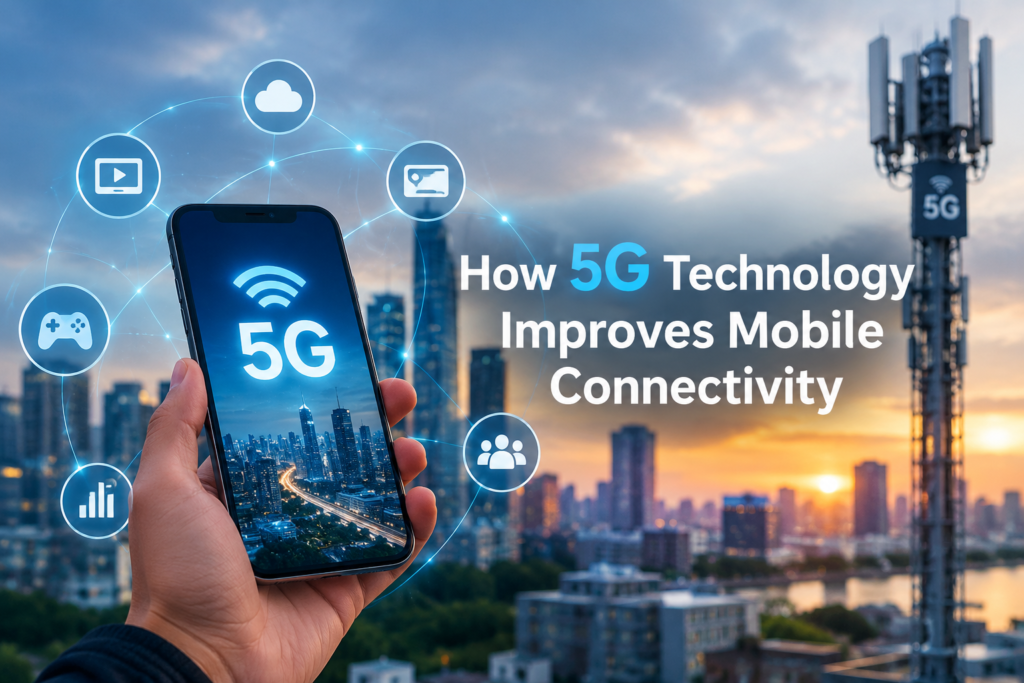
How 5G Technology Improves Mobile Connectivity
5G technology is changing the way people connect to the internet, communicate with others, and use mobile devices in everyday life. As the fifth generation of wireless networks, it offers the potential for faster data speeds, lower latency, and greater network capacity than earlier mobile technologies. These improvements help smartphones, connected devices, and digital services work more efficiently.
Mobile connectivity has become essential for online communication, remote work, entertainment, education, and business operations. However, older networks can struggle when many users access the internet at the same time or when applications require a quick response. 5G technology addresses many of these challenges by introducing advanced wireless capabilities.
Understanding how this technology works helps explain why it matters. From smoother video streaming to more responsive online gaming, 5G can improve many aspects of the mobile experience, although its performance depends on network coverage, device compatibility, and local conditions.
What Is 5G Technology?
5G stands for fifth-generation mobile network technology. It follows earlier generations, including 3G and 4G LTE, which helped expand mobile internet access and support increasingly demanding digital services.
The main purpose of 5G is to improve the way data travels between mobile devices and network infrastructure. It can support higher data rates, reduce communication delays, and connect more devices within a given area.
Unlike a technology that focuses only on download speed, 5G is designed to support several types of connectivity needs. These include high-bandwidth applications, time-sensitive communication, and large numbers of connected devices.
For example, a smartphone user may benefit from quicker downloads, while a business may use a 5G connection to support connected equipment or transfer information from remote locations. The exact benefits depend on how the network is deployed and what the connected device requires.
How 5G Technology Improves Mobile Connectivity
Faster Internet Speeds
One of the most noticeable advantages of 5G is its potential to deliver faster mobile internet speeds than 4G LTE. This improvement can make everyday online activities more convenient, particularly when transferring large files or accessing high-quality media.
With a suitable device and strong network coverage, users may experience quicker downloads, faster application updates, and smoother access to cloud-based services. High-resolution videos can also load more quickly when the connection has enough available bandwidth.
However, 5G does not guarantee the same speed everywhere. Network congestion, signal strength, frequency bands, and the distance from network equipment all influence performance. Some 5G connections may offer only modest improvements over a strong 4G connection.
Lower Latency and Faster Responses
Latency refers to the time required for data to travel between a device and a server. Lower latency allows connected applications to respond more quickly, which is especially useful for activities that depend on rapid communication.
For instance, online gamers may benefit from more responsive controls, while people using interactive applications may experience fewer noticeable delays. Businesses can also use low-latency connections for certain remote monitoring and control tasks.
Nevertheless, the overall response time depends on more than the mobile network. Server distance, internet routing, application design, and network conditions also affect latency. Not every 5G connection will provide the same results.
More Reliable Connectivity in Busy Areas
Crowded locations can place considerable pressure on mobile networks. Concerts, stadiums, shopping centres, transport stations, and busy city streets may contain thousands of people trying to connect simultaneously.
5G introduces technologies that can help networks manage this demand more efficiently. Depending on the deployment, these include wider available bandwidth, advanced antenna systems, and improved use of radio resources.
As a result, mobile users may experience fewer slowdowns when accessing online services in busy areas. However, actual performance depends on network capacity and how much infrastructure has been installed locally.

Key Features That Make 5G Different
Advanced Radio Frequencies
5G networks operate across different frequency ranges. Lower frequencies can provide wider coverage and better indoor reach, while mid-band frequencies offer a useful balance between coverage and speed.
Millimetre-wave frequencies can deliver very high speeds and substantial capacity, but their signals generally travel shorter distances and can be more easily blocked by buildings and other obstacles.
Using different frequency bands allows network operators to balance coverage, capacity, and performance according to local requirements.
Massive MIMO Technology
Massive multiple-input multiple-output, commonly called Massive MIMO, uses multiple antennas to transmit and receive data. This approach can help a network serve more users and use available radio resources more efficiently.
It can also improve the way signals reach connected devices, particularly when combined with beamforming. Rather than relying on a single broad transmission pattern, beamforming directs radio energy towards particular devices when conditions allow.
These technologies help support the higher capacity and improved performance associated with many 5G deployments.
Network Slicing
Network slicing allows an operator to create logically separated network environments with different performance characteristics on shared physical infrastructure.
For example, one network slice may be configured for a business application with specific reliability requirements, while another supports general consumer internet traffic.
This capability can help operators manage different service needs more effectively. However, network slicing depends on the operator’s infrastructure and service offerings, so it is not automatically available to every mobile customer.
Everyday Benefits of 5G Connectivity
Smoother Video Streaming
Video streaming has become a major part of mobile internet use. Higher-quality video requires sufficient bandwidth, particularly when content is streamed in high definition or 4K.
A strong 5G connection can reduce loading times and help compatible devices stream high-quality content with fewer interruptions. Faster downloads can also make it easier to save videos for offline viewing.
Streaming quality still depends on the service provider, device capabilities, available bandwidth, and the stability of the connection. A reliable 4G network may perform better than a congested 5G network in some locations.
Better Online Gaming
Online games often rely on quick communication between a player’s device and a remote server. Delays can affect movement, timing, and interaction, especially in competitive multiplayer games.
5G can improve this experience by providing higher speeds and the potential for lower latency. It may also make cloud gaming more practical by helping compatible devices receive streamed game content efficiently.
However, a good gaming experience still requires a suitable server connection, stable network performance, and a responsive device. Low latency is helpful, but it cannot eliminate every source of delay.
Improved Video Calls and Remote Work
Video meetings, online classes, and remote collaboration tools depend on a stable internet connection. Poor connectivity can cause frozen images, distorted audio, and interrupted conversations.
5G can support smoother video calls and faster access to cloud-based documents when sufficient network capacity is available. It may also help workers in locations where fixed broadband is limited or unavailable.
For businesses with mobile employees, this flexibility can improve access to digital tools. Even so, a stable connection and suitable security measures remain important for productive remote work.
How 5G Supports Smart Devices and the Internet of Things
The Internet of Things, or IoT, refers to physical devices that collect, send, or receive information through a network. Examples include smart meters, connected vehicles, industrial sensors, and some home automation systems.
5G can support IoT deployments by providing connectivity options for devices with different communication requirements. Some applications need high data speeds, while others send small amounts of information and prioritise low power consumption or reliable coverage.
Smart Homes and Connected Devices
Smart home systems may include security cameras, sensors, connected appliances, and automated lighting. A suitable 5G connection can provide an alternative way to connect a home to the internet, particularly through fixed wireless access.
This may help households in areas where installing traditional broadband is difficult. However, 5G does not automatically improve communication between every smart home device. Many devices still rely on Wi-Fi, Bluetooth, Zigbee, or other local communication technologies.
Smart Cities and Public Services
Smart city projects can use connected sensors to monitor traffic, street lighting, environmental conditions, and public infrastructure. 5G can provide network capacity for certain deployments, helping systems exchange information and support more timely decisions.
For example, traffic monitoring equipment may send data to a central system for analysis. Public services can then use that information to identify congestion or plan maintenance.
The success of these projects depends on more than connectivity. Effective planning, data protection, reliable infrastructure, and appropriate funding are also necessary.
The Role of 5G in Business and Industry
Businesses increasingly depend on connected systems to manage operations, communicate with customers, and process information. 5G can support these activities by offering flexible wireless connectivity and higher capacity in suitable environments.
Faster Data Transfer and Cloud Access
Employees often use cloud platforms to access documents, collaborate with colleagues, and manage business applications. A strong 5G connection can improve access to these services, especially for mobile teams working away from fixed office networks.
Faster data transfer can also help field workers upload photographs, reports, and other large files without relying on a wired connection.
Automation and Remote Monitoring
Some industrial environments use connected sensors and equipment to monitor performance, detect faults, and coordinate automated processes. 5G can support these systems when their communication requirements match the network’s capabilities.
Private 5G networks may also be deployed within factories, warehouses, and industrial facilities to provide controlled connectivity for compatible equipment.
However, safety-critical applications require careful engineering, appropriate safeguards, and tested performance. A public mobile network should not be assumed to meet every industrial reliability requirement.
5G Technology Compared With 4G LTE
Both 4G and 5G provide mobile internet access, but they differ in their technical capabilities and potential uses.
| Feature | 4G LTE | 5G |
|---|---|---|
| Data speeds | Suitable for most everyday mobile tasks | Can deliver much higher speeds under suitable conditions |
| Latency | Generally higher | Can provide lower latency in suitable deployments |
| Network capacity | Effective for established mobile services | Designed to support greater capacity in many deployments |
| Connected devices | Supports smartphones and many IoT services | Offers additional options for large-scale device connectivity |
| Coverage | Established across many regions | Varies significantly by location and frequency band |
| Applications | Browsing, streaming, calls, and online gaming | Supports these activities alongside newer industrial and connected applications |
The comparison does not mean that 5G always outperforms 4G in every situation. A well-developed 4G network may provide more consistent service in an area where 5G coverage is weak or limited.
For mobile users, the practical difference depends on local network quality, the type of device being used, and the applications involved.
Challenges and Limitations of 5G Technology
Despite its advantages, 5G has several challenges that affect its availability and performance.
Limited Coverage in Some Areas
Network operators need suitable infrastructure and spectrum access to provide 5G services. Coverage may be strong in city centres but weaker in rural areas or inside buildings.
High-frequency deployments can require more closely spaced equipment because their signals generally cover shorter distances. Expanding coverage can therefore involve significant investment.
Device Compatibility
A smartphone must support the relevant 5G frequency bands to use a particular network effectively. Older devices may not support 5G at all, while some compatible devices may lack support for certain local bands.
Users also need a suitable mobile plan and access to an operator that provides 5G service in their area.
Infrastructure and Deployment Costs
Building and maintaining 5G networks requires investment in radio equipment, fibre connections, power systems, and other supporting infrastructure.
These costs can affect how quickly operators expand their services. In some regions, geography, electricity availability, and the cost of backhaul connections create additional barriers.
Security and Privacy Considerations
Like other connected technologies, 5G introduces security and privacy considerations. Connected devices, network infrastructure, applications, and the data they exchange must be protected against misuse and unauthorised access.
Network operators use security controls, but businesses and consumers also need sensible practices. These include installing software updates, using strong authentication, and checking the privacy settings of connected devices.

What the Future of Mobile Connectivity May Look Like
5G is expected to remain an important part of the development of mobile communication. As coverage expands and network technology improves, more services may take advantage of its speed, capacity, and flexible connectivity options.
Developments in augmented reality, connected transport, industrial automation, and cloud-based applications may create new uses for mobile networks. Some applications will benefit from faster data transfer, while others will depend on more consistent response times or support for large numbers of devices.
Further improvements will also depend on the development of compatible devices, suitable software, affordable services, and reliable infrastructure. The benefits will not arrive at the same pace everywhere.
Future mobile networks may build on 5G capabilities, but their real value will depend on solving practical communication problems rather than simply offering higher technical specifications.
Conclusion
5G technology improves mobile connectivity by offering the potential for faster data speeds, lower latency, greater network capacity, and support for a wider range of connected devices. These capabilities can improve video streaming, online gaming, remote work, smart home services, and industrial communication.
However, the benefits depend on network coverage, device compatibility, available infrastructure, and local conditions. Some users may notice a major improvement, while others may experience only a small difference compared with 4G LTE.
As network deployment continues, 5G can help create new opportunities for communication and digital services. Its greatest value lies in making mobile connectivity more capable and adaptable to the growing needs of people, businesses, and connected systems.
FAQs
How does 5G improve mobile connectivity?
5G can improve mobile connectivity through higher data speeds, lower latency, and increased network capacity. These features can make downloads, video streaming, online gaming, and other connected activities more responsive.
Is 5G faster than 4G LTE?
5G can be considerably faster than 4G LTE under suitable conditions. However, actual speeds depend on network coverage, frequency bands, congestion, device compatibility, and the operator’s infrastructure.
Does 5G improve online gaming?
Yes, 5G can improve online gaming by providing higher bandwidth and potentially lower latency. The actual experience also depends on the game server, network stability, and the player’s device.
Does a smartphone need special hardware for 5G?
Yes. A smartphone needs a compatible 5G modem and support for the frequency bands used by the local network. A suitable mobile plan and available 5G coverage are also necessary.
What are the main disadvantages of 5G technology?
The main challenges include uneven coverage, infrastructure costs, device compatibility, and security considerations. Performance can also vary depending on the frequency band, network congestion, and local conditions.
Read Also: Cybersecurity Practices for Everyday Internet Users