

Machine Learning vs Traditional Programming
Machine learning vs traditional programming is an important comparison for understanding how modern software solves problems. Both approaches help developers process information, automate tasks, and build useful applications. However, they differ in how they reach a result. Traditional programming relies on rules written by developers, while machine learning uses data to identify patterns and make predictions. Understanding these differences helps businesses, students, and developers choose the right approach for their needs. Each method has its own strengths, limitations, and practical uses, depending on the problem being solved.
What Is Traditional Programming?
Traditional programming is a software development approach in which developers write explicit instructions for a computer to follow. These instructions define how the system should process input, apply rules, and produce an output.
For example, a calculator uses predefined mathematical rules to perform addition, subtraction, multiplication, and division. When a user enters two numbers, the program follows its instructions to calculate the answer.
This approach works particularly well when a problem has clear rules and predictable outcomes. Developers can control the program’s behavior by changing its code whenever requirements change.
How Traditional Programming Works
Traditional programming follows a straightforward process. Developers analyze a problem, create logical rules, write code, test the software, and correct errors when necessary.
The basic process involves three elements:
- Input: Information provided to the program.
- Rules and logic: Instructions that determine how the input should be processed.
- Output: The result produced by following those instructions.
For instance, an online store may use traditional programming to calculate shipping costs based on package weight, delivery location, and selected shipping method. The system applies predefined conditions to determine the final price.
Because the rules are explicitly written, developers can often trace how a particular result was produced.
Advantages of Traditional Programming
Traditional programming offers several benefits for software development.
- Predictable results: The program follows defined instructions, making its behavior easier to anticipate.
- Greater control: Developers can specify exactly how the system should respond to different inputs.
- Straightforward testing: Individual rules can be tested against expected results.
- Suitable for rule-based tasks: It works well for calculations, form validation, billing systems, and standard business processes.
- No training data required: Most conventional programs can operate without machine learning datasets.
These strengths make traditional programming a practical choice for many everyday software applications.
Limitations of Traditional Programming
Despite its advantages, this method can become difficult to maintain when a problem involves too many changing conditions.
Developers may need to write extensive rules to handle different situations. If the environment changes frequently, those rules may require repeated updates.
For example, a basic spam filter based on fixed words may identify obvious unwanted messages but struggle with new phrases, changing writing styles, and unfamiliar spam techniques.
Traditional programming can still handle complex tasks, but systems that depend on large numbers of manually defined rules may become harder to update and scale.
What Is Machine Learning?
Machine learning is a branch of artificial intelligence that enables computer systems to learn patterns from data and use those patterns to make predictions or decisions.
Instead of manually writing every rule, developers train a model using relevant examples. The model adjusts its internal parameters during training to identify relationships within the data.
For example, an email service can use machine learning to classify messages as spam or legitimate mail. By learning from previously labeled examples, the model can recognize patterns that may be difficult to describe through simple fixed rules.
Machine learning is especially useful when the underlying patterns are complex or when new data can help improve performance.
How Machine Learning Works
A typical machine learning workflow includes several stages.
1. Data collection
The process begins with gathering relevant information. Depending on the task, this could include images, customer transactions, product reviews, or historical sales records.
2. Data preparation
The collected information is cleaned and organized. Missing values, inconsistent formats, and irrelevant details may need attention before training begins.
3. Model training
A learning algorithm processes the prepared data and adjusts the model’s parameters to capture useful patterns.
4. Evaluation
Developers test the trained model using data that was not used for training. This helps determine how well it performs on unfamiliar examples.
5. Deployment and monitoring
Once the model meets the required performance standards, it can be integrated into an application. Its results should be monitored because changing data may reduce its accuracy over time.
Unlike a fixed rule-based system, a trained model can generalize from examples. However, its predictions are not guaranteed to be correct.
Advantages of Machine Learning
Machine learning provides several benefits for problems involving complex patterns and large datasets.
- Pattern recognition: Models can identify relationships that are difficult to express through manual rules.
- Prediction: Historical data can help estimate future outcomes, such as product demand or customer churn.
- Automation: Some classification, recommendation, and detection tasks can be handled with less manual intervention.
- Adaptability through retraining: Models can be updated with new data to reflect changing patterns.
- Personalization: Recommendation systems can use user behavior to suggest relevant products, videos, or content.
These capabilities make machine learning valuable in areas such as fraud detection, image recognition, language processing, and predictive maintenance.
Limitations of Machine Learning
Machine learning also introduces challenges that developers must consider.
Models often require suitable training data, sufficient computing resources, and careful evaluation. Poor-quality or biased data can lead to inaccurate or unfair results.
Some models are also difficult to interpret, particularly when their predictions depend on complex relationships across many variables. This can create problems in applications that require clear explanations.
Another limitation is that machine learning does not automatically improve simply because more data becomes available. The data must be relevant, the training process must be appropriate, and the model must be evaluated against the intended task.
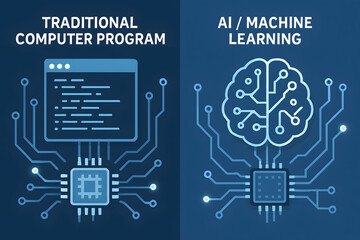
Machine Learning vs Traditional Programming: Key Differences
The main difference lies in how each approach produces results. Traditional programming applies instructions written by developers, whereas machine learning learns patterns from examples to generate predictions or decisions.
| Feature | Traditional Programming | Machine Learning |
|---|---|---|
| Main approach | Follows explicitly written rules | Learns patterns from data |
| Development process | Developers define the logic | Developers select and train a model |
| Data requirements | Depends on the application | Usually requires relevant training data |
| Output | Determined by code and input | Determined by the trained model and input |
| Predictability | Often easier to trace when rules are clear | Predictions may be uncertain |
| Maintenance | Rules and code are updated | Models may require retraining and monitoring |
| Best suited for | Defined, rule-based tasks | Complex patterns and prediction tasks |
| Testing | Checks whether the code follows expected rules | Evaluates performance on unseen data |
Neither approach is universally better. The appropriate choice depends on the task, available resources, acceptable error rate, and need for explainability.
Real-World Examples of Both Approaches
Practical examples make the differences easier to understand.
Traditional Programming in Everyday Applications
Traditional programming powers many systems that depend on explicit rules.
Banking calculations: Software calculates interest according to defined rates and account conditions.
Online shopping: Websites check whether required fields have been completed, apply discounts, and calculate order totals.
Booking systems: Applications verify available dates, apply pricing rules, and confirm reservations.
Inventory management: A system can trigger a reorder alert when stock falls below a specified level.
These tasks generally work well when the rules are known and can be expressed clearly.
Machine Learning in Everyday Applications
Machine learning is useful when software needs to identify patterns from examples.
Recommendation systems: Streaming platforms can analyze viewing behavior to recommend potentially interesting content.
Fraud detection: Financial institutions can use models to identify transactions that differ from normal activity.
Image recognition: Computer vision models can classify images or detect objects within photographs.
Demand forecasting: Businesses can analyze historical sales and other relevant variables to estimate future demand.
These applications benefit from learning patterns that may be too complicated to capture with a small set of fixed rules.
Can Machine Learning and Traditional Programming Work Together?
Yes. Many modern applications combine both approaches to achieve better results.
Traditional programming can manage the parts of a system that require clear rules, while machine learning handles tasks that involve uncertain patterns or predictions.
For example, an online payment platform might use a machine learning model to estimate whether a transaction is suspicious. Traditional programming can then apply predefined policies, request additional verification, or block a transaction when required conditions are met.
This combined approach allows developers to retain control over important business rules while benefiting from data-driven predictions.
However, the integration requires careful testing. A model’s prediction should not automatically trigger a high-impact action unless the system has appropriate safeguards and validation.
Which Approach Is Better for a Project?
The best choice depends on the problem rather than on which technology appears more advanced.
Traditional programming is often the better option when the task follows clear rules, requires predictable results, and does not benefit significantly from learning patterns in data.
Machine learning may be more suitable when the task involves large datasets, complex relationships, image or language recognition, or predictions based on historical examples.
Before making a decision, developers should consider the following factors:
- Problem complexity: Can the task be solved reliably using explicit rules?
- Data availability: Is enough relevant, high-quality data available for training and evaluation?
- Accuracy requirements: What kinds of errors are acceptable, and what happens when a prediction is wrong?
- Maintenance costs: Would updating rules be simpler than maintaining a trained model?
- Explainability: Does the application require a clear explanation for every decision?
- Available resources: Can the project support the required development, computing, testing, and monitoring costs?
For smaller, well-defined tasks, conventional code may be simpler and less expensive. For complex pattern-recognition tasks, machine learning may provide capabilities that rule-based logic cannot easily deliver.

The Future of Software Development
Both approaches continue to play important roles in software development. Traditional programming remains essential for application logic, data processing, system integration, and enforcing business rules.
Machine learning expands what software can do by enabling prediction, personalization, and recognition of complex patterns. As tools and development practices evolve, more applications are likely to combine learned models with conventional code.
Even so, successful implementation requires more than selecting a technology. Developers must understand the problem, assess the available data, test performance, and account for security, privacy, and reliability.
The strongest solutions are those that use each method where it provides the clearest practical benefit.
Conclusion
Machine learning and traditional programming solve problems in different ways. Traditional programming relies on explicit instructions and works particularly well for predictable, rule-based tasks. Machine learning learns patterns from data and can be useful for predictions, classification, and complex recognition problems.
Neither approach replaces the other in every situation. Many applications benefit from combining learned models with carefully designed software rules. By considering the task, data requirements, maintenance needs, and consequences of errors, developers can choose an approach that fits the project’s goals.
The key is to select the simplest effective solution rather than using a more complex method when it offers no meaningful advantage.
FAQs
1. What is the main difference between machine learning and traditional programming?
Traditional programming follows rules written by developers, while machine learning learns patterns from data to make predictions or decisions.
2. Which is better, machine learning or traditional programming?
Neither is always better. Traditional programming works well for fixed rules, while machine learning is useful for complex patterns and predictions.
3. Can machine learning work without programming?
No. Machine learning requires programming or specialized tools to prepare data, train models, and use their results.
4. What are examples of traditional programming and machine learning?
Traditional programming includes calculators and rule-based billing systems. Machine learning powers recommendation systems, spam filters, and image recognition.
5. Is machine learning more expensive than traditional programming?
Machine learning can cost more because it may require large datasets, computing resources, and model training. Traditional programming is often simpler for predictable tasks.